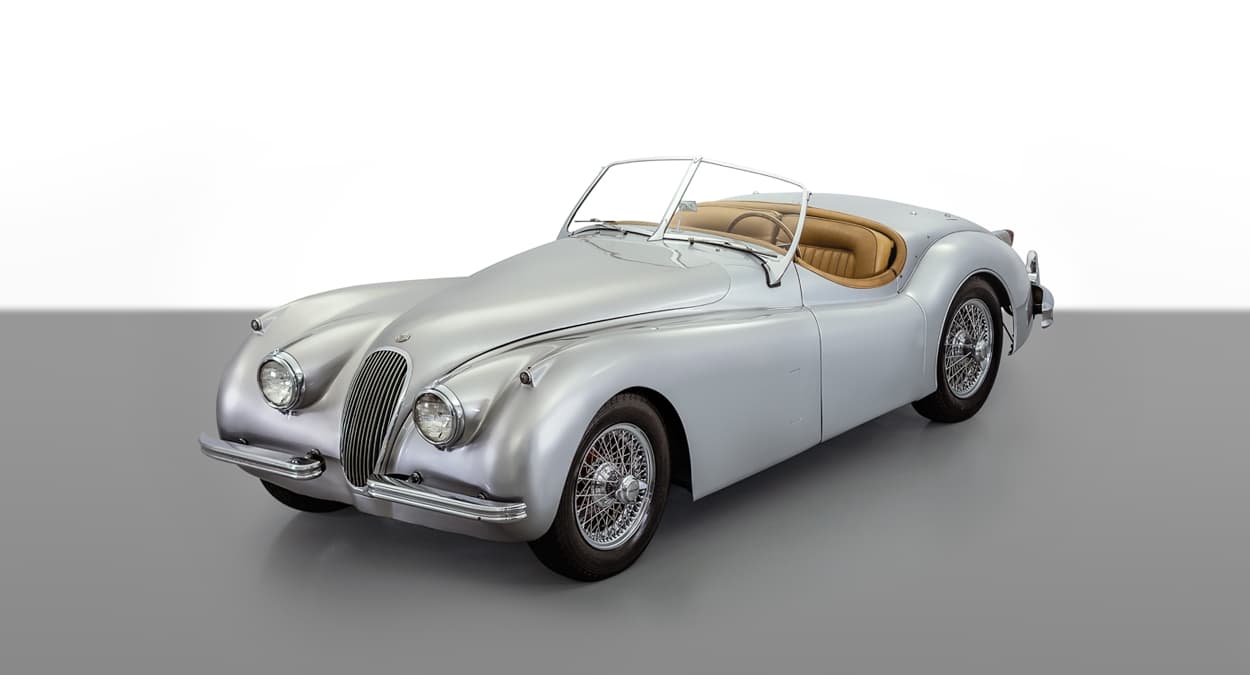
1953 JaguarXK120
3.4L XK DOHC Inline-Six
Gallery

Currently in the private collection
Florida, United States · Lubeck Garage
The 1953 Jaguar XK120 joined three stories at once: production-car glamour, public speed-record theatre, and Jaguar's Le Mans ascent. The XK120 was a sensation because it made 120 mph credible in a showroom car. By 1953, Jaguar test driver Norman Dewis had taken an aerodynamically modified XK120 at Jabbeke, Belgium, to a two-way average of 172.412 mph, a figure that still feels outrageous for a car of its era.

XK120
A Jaguar XK120 with its bonnet raised over the XK twin-cam straight-six, the engine behind the Jaguar postwar performance era. Wikimedia Commons · Thomas Vogt · CC BY 2.0
Full Specifications
Engine
3.4L XK DOHC inline-six
Power
160 bhp (180 bhp Special Equipment)
Transmission
4-speed manual
Record Speed
172.412 mph (1953 Jabbeke, modified)
1949 Demonstration
132.596 mph (windscreen removed)
Production
12,045 across OTS, FHC, and DHC
Le Mans Link
XK engine powered C-Type wins, 1951 & 1953
Advertised
120 mph production claim
Chronicle
Key Dates & Events
1948
Jaguar reveals the XK120, named for its advertised 120 mph capability.
May 1949
At Jabbeke, an XK120 demonstrates 132.596 mph with windscreen removed and airflow aids fitted.
1950
Production shifts from early aluminium bodies to steel-bodied XK120s.
1951
The Jaguar C-Type, on XK engine architecture, wins the 24 Hours of Le Mans.
1952
An XK120 fixed-head coupe averages 100.31 mph for seven days and nights at Montlhéry.
21 October 1953
Norman Dewis drives a modified XK120 to 172.412 mph at Jabbeke.
1953
The C-Type wins Le Mans again, cementing the XK engine's competition reputation.
1954
The XK140 succeeds the XK120, continuing the line.