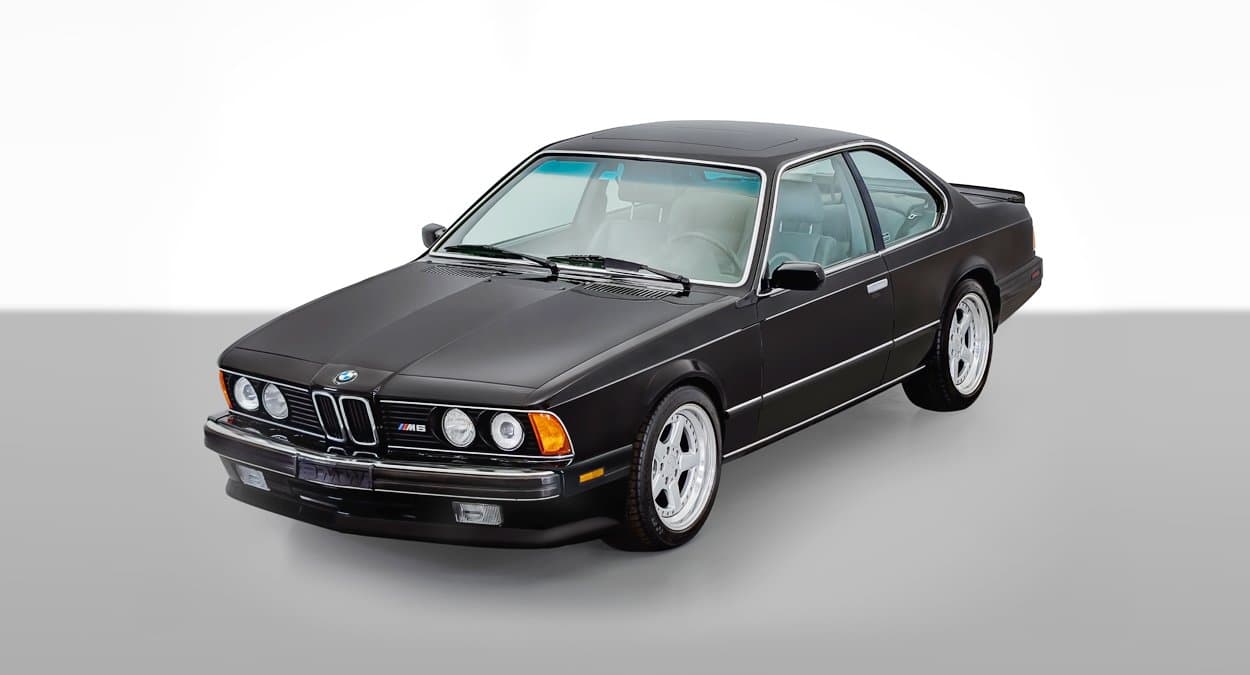
1988 BMW M6: the full story
Introduced in 1983 by BMW’s Motorsport division, the M6 emerged as a high performance version of the 6 Series. Beginning with the E24-generation M635CSi, the M6 was conceived as a grand tourer rather than an overt supercar, emphasizing long-distance comfort. These early models varied by market: European versions featured the more potent M88/3 engine while North American and Japanese cars adopted the catalyzed S38B35. Though the European cars later adopted these specifications in 1987, the initial distinction between markets only adds to the M6’s character.
This 1988 model features the celebrated S38 (S38B35) motorsports engine, which derives from the M88 straight-six that famously sat behind the passengers in the original BMW M1. Though slightly civilized for street duty, the 3.5-litre S38 retains the race-bred technology that made it so desirable. Paired with a 5-speed Getrag 280 manual transmission and rear wheel drive, and further enhanced by a tactile MOMO shifter, it offers an experience that modern cars rarely attempt to emulate.
Introduced initially as a coupé, the M6 expanded across later generations to include convertible and “Gran Coupé” fastback sedan body styles, with a version offered for each of the first three 6 Series generations. This car is a two-door coupé from the E24 generation (1983-1989), featuring a low-slung design with a shark-like nose, and pillarless side glass. Unlike many performance cars of its era, the M6 does not rely on aggressive ornamentation. Step inside, and one of the first revelations is visibility. The expansive greenhouse and thin A-pillars create an airy, commanding view outward and minimize blind spots.
The M6’s interior emphasizes driver-focused support. Hand-stitched leather, four deeply bolstered seats, and an ergonomically oriented cockpit create a comfortable and driver-friendly environment. The manual gearbox and shifter elevate the experience, reinforcing the car’s intent to be driven, not simply admired. Today, the analog instrumentation and tactile controls recall an era when feedback and feel mattered more than screens and software.
Driving the M6 reveals its personality. The clutch carries a weight and feedback absent in contemporary cars, demanding (and quickly building) a stronger left leg. The gearshift sits far forward, delivering a relaxed but deliberate action. Clutch take-up is sharp, and within moments, the car sheds any notion of being a static collectible. Within a mile, it becomes clear that the M6 is not a museum piece reserved for display. It is meant for the road.
On the move, the S38 engine defines the experience. Its large displacement and exceptional cylinder head flow allow it to punch well above its weight. Accelerating from 0-60 in 5.9 seconds, the M6’s top speed of 158 mph made it the second fastest BMW at the time, behind the M1. Even partial throttle inputs produce a forceful surge, pressing you back into the seat with power that was nothing short of astonishing in the 1980s, and also remains deeply impressive today.
The M6’s rarity only deepens its enduring appeal. Of the 5,855 E24 M6 models produced globally between 1983 and 1989, roughly 1,600–1,700 reached North America, with as few as
319 built for the U.S. market in 1988 alone. By its final years, the E24 had evolved into a “world car,” sharing unified design and performance characteristics across markets. BMW produced later versions of the M6 through 2019 (with a hiatus from 1990 to 2004) before moving on with the BMW M8. Decades later, the brilliantly fast and thoughtfully engineered 1988 M6 remains every bit of a true driver’s car.