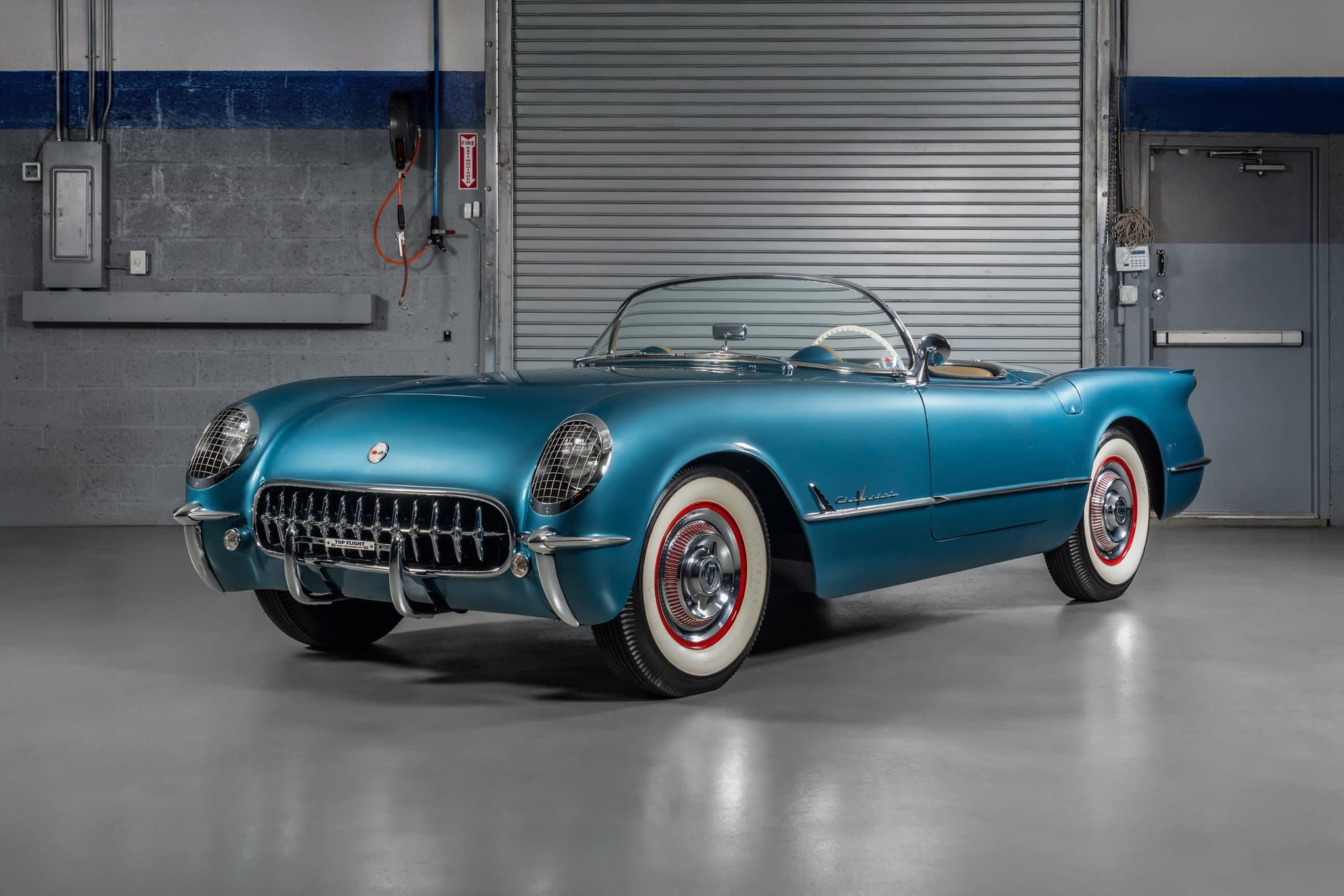
1955 Chevrolet Corvette C1: the full story
In the early 1950s, Chevrolet set out to build a sports car and ended up creating a legend. Inspired by the small warship for which it was named, the Corvette began as a daring concept and evolved into Chevrolet’s halo car, bringing people into showrooms purely through aspiration. As the first two-seat sports car produced by a major American manufacturer, the Corvette’s place in automotive history was instantly cemented. If the very first models built in 1953–54 were bold experiments, the 1955 Corvette was the proof of concept. It is the car that solidified the Corvette identity, marked a turning point for Chevrolet, and set the stage for seven decades of excellence.
The 1955 C1 is one of the most significant chapters in the Corvette story. While the year is best known for introducing V8 power, the first generation Corvette offered two configurations. This car represents the rarest and most historically important of them all. The “Blue Flame Powerglide” variant features the 235-cubic-inch inline-six engine and 2-speed automatic transmission. The C1 was produced between June 1953 and July 1962. The 1955 model year is the second rarest C1 after the inaugural 1953 model. Out of the 700 Corvette C1s produced that year, 693 were built with the new V8 engine and only seven had the inline six-cylinder engine.
This generation is commonly referred to as the "solid-axle" generation, featuring an independent front suspension as independent rear suspension did not appear until the 1963 Sting Ray. The C1 Corvette kept the original chassis and suspension from full size Chevrolets through 1962 because reengineering was too costly, uncertainty surrounding the model’s future, and the newer full-size suspension was too heavy for the lightweight Corvette.
With rear wheel drive, a curb weight of 2,840 lbs, and a fuel capacity of 17.3 gallons, this 1955 C1 remains a direct window into the groundwork laid for Corvette’s powertrain evolution. Preserving a car like this with its original drivetrain is not just historically accurate but is essential. It captures the Corvette’s inception before it solidified its place in the American automotive lineage.
The design remains one of the most timeless forms ever to emerge from GM Styling. The 1955 model preserved the C1’s nautical-inspired shape, molded fiberglass curves, the chrome tooth-bar grille, and flowing fenders. The exterior scallops are smooth rather than aggressive, giving the ’55 a sporty yet welcoming appeal, which has always been part of the Corvette’s charm. The car’s cabin is also classically stunning. The monolithic dash integrates gauges into its shape (as opposed to the common look of gauges bolted onto an existing surface). The result is a sleek and clean look that’s pleasing to the eye. The seats’ stitching is uniform and taught, like a perfect pinstriped suit. The same stitching patterns continue on the interior panels of the doors, creating an interior that feels comfortable and surprisingly modern in its execution.
The 1955 C1 is the Corvette in its foundational form, and a rare configuration of one of the most important sports cars ever built. A true original, it marks the beginning of Corvette’s sports car identity and embodies the spirit of progress that would lead to the great supercars of future decades.