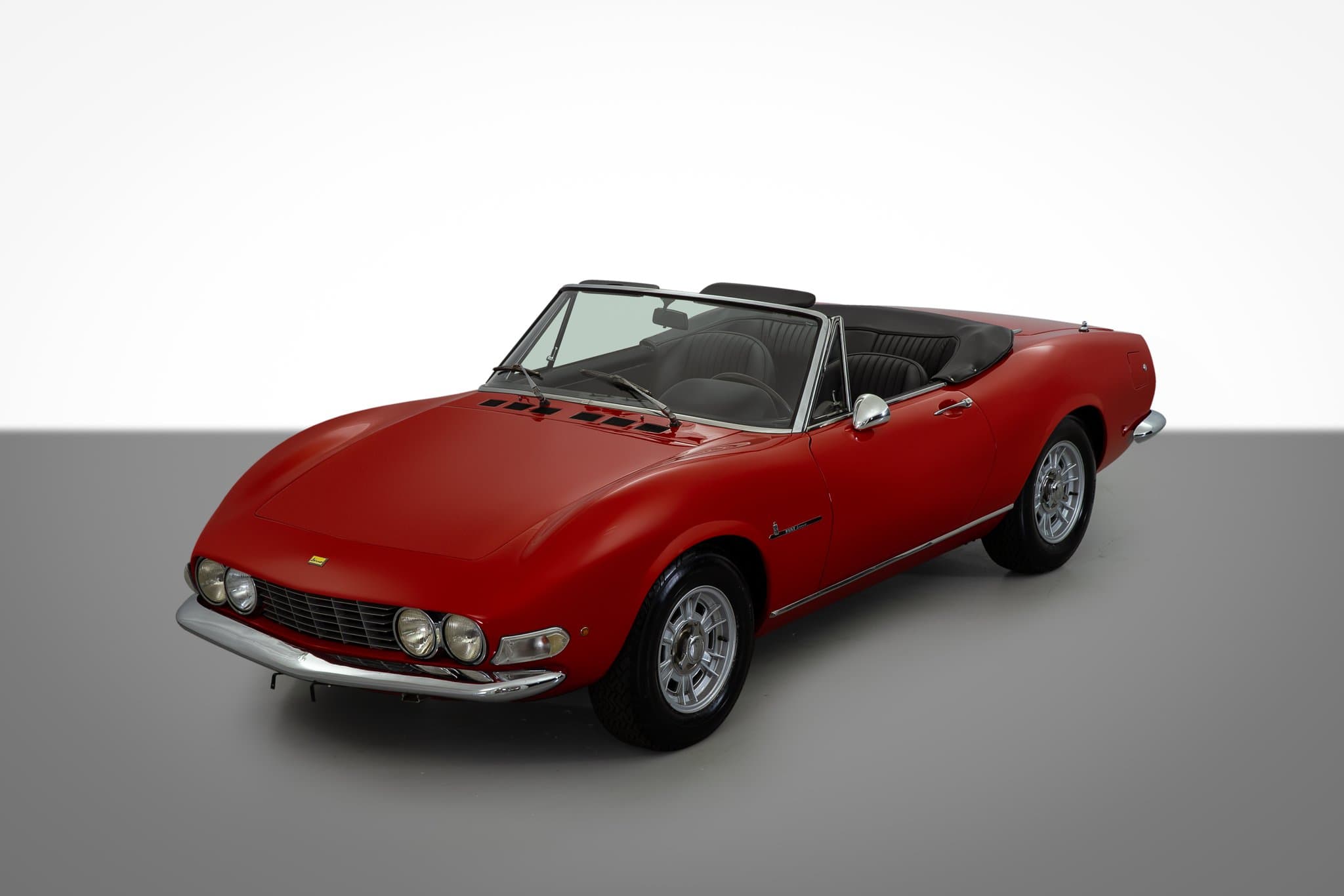
1967 Fiat 124 Sport Spider: the full story
The story of the Fiat Dino begins with an unusual collaboration between Fiat and Ferrari. In 1965, Ferrari needed to produce a six-cylinder engine in sufficient numbers to satisfy Formula 2 homologation requirements, calling for 500 engines to be produced within 12 months. As Ferrari lacked the production capacity to meet that quota, Fiat agreed to build the engines. The result was an all-aluminum 2.0-liter V6, developed for road use by Aurelio Lampredi. The “Dino” name honored Enzo Ferrari’s son, Alfredo, whose nickname had already been associated with Ferrari’s V6-powered racing cars. The sophisticated V6 gave the relatively lightweight car exceptional performance, establishing the Dino as one of Fiat’s most respected gems.
The 1967 Fiat Dino Spider is one of the most fascinating Italian sports cars of its era. Unveiled at the ’67 Geneva Motor Show, the Spider features Pininfarina bodywork that has aged remarkably well. The combination of Pininfarina's design and Ferrari's mechanical influence resulted in one of the most graceful open-top sports cars of the 1960s. The Spider was officially a 2+1 seater and initially featured a more utilitarian interior, though later 1967 models received wood trim, including a wood-rimmed steering wheel.
Of the 7,803 Fiat Dinos produced between 1966 and 1973, only 26 percent were Spiders, underscoring this car’s rarity. This particular 1967 model is finished in classic Rosso Corsa with a black leather interior, black carpeting, and a black soft-top. It has been maintained by respected East Coast restoration facilities and driven only sparingly since its restoration. Period-correct details, including Chromodora wheels, an Abarth steering wheel, and its original jack, further enhance the car’s vintage appeal.
Power comes from a carbureted 2.0-liter V6, paired with a five-speed manual transmission, limited-slip differential, and four-wheel disc brakes. The unusual 65-degree engine features dual overhead camshafts, a 9:1 compression ratio, and three twin-choke Weber carburetors, while its alloy block uses cast-iron wet cylinder liners and aluminum heads. The mechanical layout remains appropriately simple for a 1960s sports car, with double-wishbone independent front suspension and a solid rear axle on semi-elliptic leaf springs. Performance is impressive, with 158 horsepower and 116 lb-ft of torque, a 0-to-60-mph time of approximately seven seconds, and a top speed of around 130 mph.
The Fiat Dino Spider occupies a unique place in automotive history as a remarkable collaboration between two of Italy’s most celebrated manufacturers, combining Pininfarina styling and a Ferrari-derived V6 in a more accessible package than Ferrari’s own Dino 206 GT. It is also a rare sight in the United States. Production of the 2.0-liter model ended in 1969, and relatively few cars made their way across the Atlantic. Its lightweight construction, responsive steering, and open-air configuration create an engaging driving experience increasingly difficult to replicate in a modern automobile. With its elegant Pininfarina bodywork, distinctive V6, and limited production, the Spider combines Italian style and mechanical character in a package that remains extremely difficult to find in this condition. Much like the 1971 Dino 2400 Coupé also featured in this collection, the Spider highlights how Fiat and Ferrari shared technology while creating remarkably different interpretations of the same sports car.