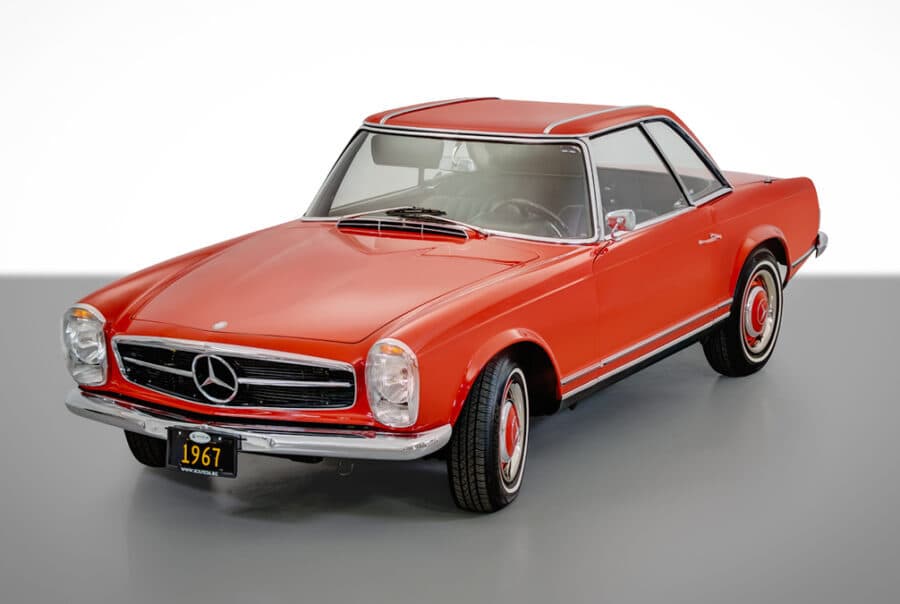
1967 Mercedes-Benz 250 SL: the full story
The Mercedes 250SL, created in 1966 and produced only until early 1968, is among the most coveted iterations of the celebrated W113 series. Its introduction at the 1967 Geneva Motor Show marked a brief but brilliant chapter in Mercedes-Benz history. With just 5,177 examples built, along with an additional 17 models built in 1966 and 2 in 1968 respectively, the 250SL is one of the rarest and most desirable vehicles of its time. Its exclusivity alone elevates it, but it is the harmonious blend of elegance, engineering, and usability that makes it an enduring classic.
Designed by Paul Bracq and Béla Barényi, the Mercedes 250SL (“Sport Leicht” or “Sport Light") is instantly recognizable by its patented concave hardtop roof, which earned it the “Pagoda” moniker. W113 SLs were typically offered as a “Coupé/Roadster” with a soft-top and optional removable hardtop, while the 250 SL “California Coupé” introduced a 2+2 layout with a fold-down rear bench seat in place of the soft-top. This shape was not only visually striking but also functional as a rigid structure that enhanced safety. The result is a car that feels both modern and timeless. This 1967 250SL represents Mercedes-Benz at its peak, producing cars that combined durability, performance, and unmatched sophistication. It is a classic that has never fallen out of style.
Mechanically, this 250SL blends tradition with innovation. Its 5-liter inline-six engine, equipped with Bosch fuel injection and a single overhead cam, produces 148 horsepower and 159 lb-ft of torque. Paired with a Daimler-Benz 4-speed automatic transmission, the car delivers seamless power and a top speed of 125 mph, making it a formidable performer for its day. More importantly, it drives with the smoothness and composure that defined Mercedes engineering at the time. Four-wheel disc brakes, introduced on the 250SL, give it stopping power to match its performance, making it both a refined tourer and a capable sports car.
Mercedes-Benz never focused on performance alone. The 250SL was the first sports car to embody the brand’s pioneering safety philosophy, introducing the world’s first “safety body” with crumple zones and impact-absorbing sections integrated into its structure. The interior was deliberately softened: sharp edges and hard corners were eliminated, the steering wheel was collapsible with a padded hub, and controls were made safer with concave knobs, elastic rubber heater levers, and a dash with rounded padding. This marriage of safety and luxury was a defining trait of Mercedes-Benz in the 1960s, and it also positioned the 250SL as both an exhilarating and reassuring car to drive.
Design, of course, remains at the heart of the 1967 Mercedes 250SL’s enduring appeal. The interior carried over much of the chrome-accented style of the 230SL, with supportive leather seats, a Blaupunkt radio, and gauges set within a cabin defined by upscale quality. Later examples began to preview the cleaner, more modern look of the 280SL, with updated door hardware, elastic map pockets, and more functional mirrors. Regardless of year, this car offers the unmistakable feeling of stepping into a true luxury sports car.
In August 1967, the 250 SL was updated to meet stricter U.S. safety and emissions standards, gaining features like a collapsible steering wheel, padded controls, softer dash trim, modernized
hardware, and emission equipment, while U.S. models also received side reflectors, Kangol seat belts, an illuminated shift quadrant, and a matte horn ring. Its appeal was immediate, particularly in the American market, where nearly a third of all 250SLs were sold. The ease of its clever Pagoda hardtop made it as practical as it was beautiful, equally suited for grand touring or casual weekend drives.
Today, the 1967 Mercedes-Benz 250SL endures not only as the rarest of the W113s, but as the most balanced. It combines the stiffer suspension and sportier demeanor of the 230SL with the added torque and braking refinements that would later define the 280SL. As a single-year model, it stands as a lasting testament to Mercedes-Benz’s mastery of elegance, reinvention, and preservation more than half a century later.