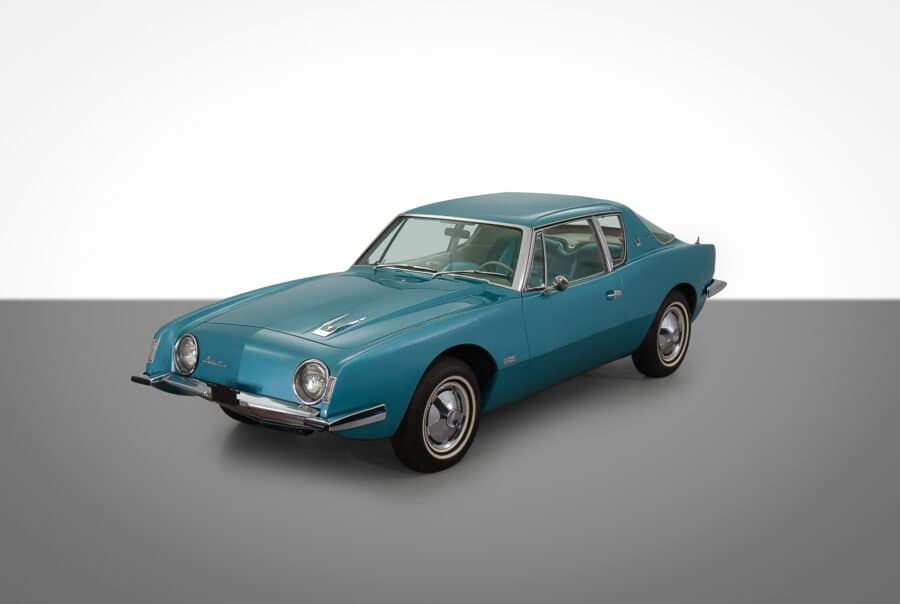
1963 Studebaker Avanti: the full story
The Studebaker Corporation faced plummeting sales in 1961, following a post-war merger and stiff competition with American automotive heavyweights. The company’s then-new president, Sherwood Egber, set out to reverse its fortunes with a four-passenger high-performance personal car that could compete with the Ford Thunderbird. The project moved forward in secrecy, entrusted to a select team spearheaded by Raymond Loewy. The result was the Studebaker Avanti, a sleek, ambitious, and unapologetically forward-thinking coupe that could stand proudly alongside any Big Three-manufactured vehicle.
The Avanti made a bold statement when it debuted at the 1962 New York Auto Show, as both a revolutionary design and a corporate gamble. With its grilleless nose, sculpted fiberglass body, and clean, jet-age aesthetic, this 1963 Studebaker Avanti presents a vision of the future that still feels avant-garde today. Studebaker had planned to build 20,000 models for the 1962 model year, but production problems led to delays and canceled orders. Only about 1,200 were completed during that initial run while this car is one of fewer than 4,600 Avantis built for 1963.
Mechanically, this 1963 Avanti was built around Studebaker’s 289 cubic-inch V8. The chassis is forward-thinking for its era, with its front suspension built around coil springs with a sway bar, and a rear setup consisting of semi-elliptic leaf springs paired with radius rods. Even with this robust architecture, the Avanti maintained a relatively lean 3,095-pound curb weight. The Avanti was the first American production car to offer British Dunlop front disc brakes. It was also one of the first bottom breather designs, feeding air under the front of the vehicle rather than a front-bumper grille, further solidifying the car’s high-performance intentions.
Inside, the 2-door, 4-seat layout offers comfortability, while bucket seats, a sport steering wheel, and a competition-style gauge cluster give the cabin a purposeful, aviation-inspired feel. Despite its emphasis on speed and style, the rear-seat space was genuinely usable, which is a rare achievement for a personal performance coupe.
The 1963 Studebaker Avanti’s bold design, unique vision, and rarity remain strikingly timeless. The car’s influence has been echoed decades later in certain Porsches, Corvettes, and Infinitis. While its production was short-lived, the Avanti saga did not end with the closure of Studebaker’s South Bend plant. Altman and Newman’s Avanti II and additional entrepreneurial ventures carried the name forward through 2006. The car’s legacy is ultimately measured in its longevity, transcending far beyond sales alone.